RURAL ANTHRAX IN ARGENTINA
Dr. Ram&oacte;n P. Noseda - Co-Director Azul Diagnosis Laboratory
1886 was a significant year for the history of rural anthrax in Argentina, because it was vaccinated for the first time with the Pasteur vaccine against anthrax in “Las Cabezas” cattle ranch in Gualeguay - Entre Ríos Province, being Dr Bidali one of the vets who worked with Louis Pasteur, who promoted the production of such vaccine in the country (1). In those days, the cattle death, like the transmission of Anthrax to humans involved in rural tasks were frequent and significant.
BOVINE STOCK AND RURAL POPULATION
In 1580 the first 500 Andalucian bovines came in brought from Paraguay by the Spanish. The British breeds burst in in 1836,as improved, absorbing in 80 years the native fenotype. At the moment, a stock of more than 48 million of bovines are a considerable livestock resource. A rural population of 3.871.000 people live with them. The concentration of this livestock production is focused in 7 provinces: Buenos Aires, Santa Fe, Córdoba, Entre Ríos, La Pampa, Corrientes and San Luis, where 42 million of livestock heads and a rural population of 1.700.000 inhabitants live (5). Buenos Aires Province with 18.000.000 bovines and 521.000 rural inhabitants is the principal livestock province in the country.
26 YEARS OF RURAL ANTHRAX EVALUATION
In 1977, Azul Diagnosis Laboratory, considering the necessity of documenting the epidemiological information of the prevalent veterinarian pathologies, starts its organization for their achievement, being catalogued as: “Polyvalent Laboratory” by the Panamerican Health Organization (OPS), together with other 233 from the rest of Latin America.(3).At the moment, 9 Professionals, Clinical Bacteriologists, Veterinarians, Biochemists, Scientific Estimating Clerks complemented by 14 Technicians, 6 Administratives and 4 Auxilliary Workers do their job in a plant of 2100m2 giving appropiate background to the instruments and different services related to diagnosis.
NETWORK OF DIAGNOSIS LABORATORIES
In 1991 Azul Diagnosis Laboratory set off the methodology of Technology and Technical Assistance Transference to other diagnosis laboratories, based on a meticulous selection. Those have a minimum functional structure to the legal requirements and its Technical Directors have the technical and ethical capacity to support them. They get: technical-administrative training, intra and extra laboratory quality controls, making such agreements legal in notarial documents. At the moment,11 Diagnosis Laboratories distributed in 5 Argentine Provinces (6 in Buenos Aires, 1 in Corrientes,1 in Cordoba,1 in San Luis and 1 in Santiago del Estero), make up this network.
BOVINE ANTHRAX INDICATORS
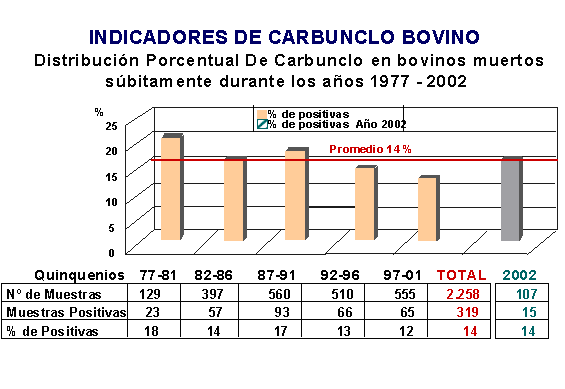
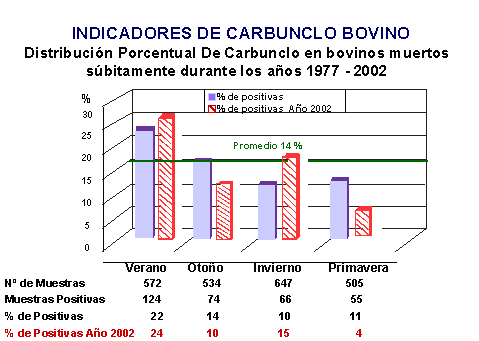
In 1960, between 800 and 1700 annual cases of animal anthrax are reported within the different succeptible species, being the bovine the most affected in Buenos Aires, La Pampa, Entre Ríos and Santa Fe Provinces (8). Although this disease has to be obligatory reported in agreement to the Sanitary Police Law, its notification in Veterinarian Medicine shows deficiency (6). Between 1977 and 2002, Azul Diagnosis Laboratory processed 2258 bovine spinal cord cultures (metatarsus-metacarpus), which 319 were positive (Bacillus Anthracis isolation and typification), this represents 14% of the samples. Those were sent by 180 Veterinarians living in 30 areas of Buenos Aires Province (9-10). The seasonal distribution of Anthrax is an epidemiological important fact to consider, since in the Summer-Autumn period,62% of the positive samples are accumulated (198 B. anthracis isolations and typifications) (10).
HUMAN ANTHRAX INDICATORS
The Argentine population is 36 million inhabitants which only 3.871.000 are considered rural population. Being Buenos Aires, Santa Fe, Córdoba, Entre Ríos, La Pampa, Corrientes and San Luis Provinces with 1.700.000 rural residents, the most closed cohabitants with the bovines.(5).Moya V. and Valdivieso A. from the Zoonosis Panamerican Center were in the 60’s, the last ones who analyzed this disease in an integral way (8). The authors mention that an average of 200 people become sick of Anthrax annually, with a mortality which varies from 10% and 18%. The distribution is very extensive, being described in 19 of the 23 Argentine Provinces. During the period between 1977-2002, 94 Anthrax cases were reported in Buenos Aires Province, from which 93 were endemic and 1 digestive (4). Of these cases,7 coincided with the bovine outbreaks diagnosed by Azul Laboratory, included the digestive Anthrax wich produce its death.(11).
EPIDEMIOLOGICAL SURVEY
During the period 1990-2002, the epidemiology of 46 bovine anthrax was studied, tending to look for antecedents that explain the endemic characteristic of the disease in Buenos Aires Province, main cattle province of the country. An average percentage og annual distribution of 14% of positive diagnosis to B. anthracis during the period between 1977-2002, where 2018 spinal cord cultures from dead bovines with presumed anthrax diagnosis were analysed, from which 279 were positive with isolation and typification to that bacteria. Parameters related to: environment, animal dynamic, immunization, clinical observations, carcass elimination were evaluated. The summer with 21% and the autumn with 14% would be the most favourable times for the disease appearance. The most outstanding data are:93% suddenly die, 67% happened on natural fields, 78% threw uncoagulable blood from the natural openings, 84% of the dead animals are adults, 72% of the rodeos where the disease was presented, the animals were not vaccinated against Anthrax,43% of the dead animals were tanned, 79% of the cattlemen did something to eliminate the carcasses but it was partially achieved.(11)
METHODOLOGY USED FOR BACILLUS ANTHRACIS DIAGNOSIS
Microbiological techniques
The same diagnosis methodology was used for the bovine, human, vaccine and soil samples. The Gram coloration and direct inmunofluorscence (IFD) test for the identification of bacterial morphologies, the 5% agar blood equine culture where morphologies, hemolisis, plasticity and consistency of the developed colonies were observed. The biochemical evaluation about isolations morphologically compatible determined: mobility, catalase, glucose, idol, ureasa, citrate, nitrite. Once made the preliminary confirmation, the method API 50 CHB with identification attended by computer APILAB PLUS bio Merieux was used as final confirmation (13).
PATHOGENECITY DEMONSTRATION
The albino Swiss mouse, 17 average gr., produced in Azul Laboratory Bioterio, CF1 strain, origin: Charles River Institute Laboratory is used. Inoculating subcutaneusly 0.3ml of a suspension 0.5 of Mc Farland scale, with an approximate concentration of 300.000 spores - bacilli, as a way to show pathogenecity. Monitoring the most evident clinical manifestations every 6 hours until its death, where the necropsy is done verifying the inoculation point (jellied edema)and evident splenomegaly, from which B. anthracis is isolated to confirm the diagnosis (12-13).
RESISTANCE TO ANTIBIOTICS OF COMMON USE IN VETERINARY
The resistance and sensibility to antibiotics were determined by the diffusion technique of Kirby-Bauer, according to N.C.C.L.S reference procedures, the disks used are Britania (Argentine Ind.)of mid - concentration. 47 strains from the period 2000-2002 were evaluated, being obtained the following resistance results: 42% to Trimetropina, 2% to Tetraciclin, 2% to Gentamicin. No showing resistance to: Penicillin, Ciprofloxacina and Florfenicol.
CEPAS AISLADAS 2000–02 |
Nº CEPAS |
ANTIBIÓTICOS - % DE RESISTENCIA |
|||||
47 |
Tetraciclinas |
Penicilina |
Trimetroprima |
Gentamicina |
Ciprofloxacina |
Florfenicol |
|
B.A.A. |
2 |
0 |
42 |
2 |
0 |
0 |
|
BOVINE IMMUNIZATION
This is one of the most significant parameters of the epidemiological survey of the period 1990-2000, 72% of the cattle ranches admitted not to vaccinate against Anthrax. Of 28% that carries it out,72% is applied by rural workers,24% by owners and only 4% by veterinarians, although it is a live vaccine. The time between the last vaccination and the disease appearance was 171 days, showing the convenience of vaccinating the ranches with disease antecedents every 6 months. The Anthrax vaccine cost is really low, the dose price does not overcome U$0,06 per animal. In a work(2) carried out in a rodeo of 315 animals of different cathegories,4 died, if vaccination had been done the cost would hav been U$59,the lost because of the Anthrax outbreak was U$1025. The non-application of the vaccine is reflected in the figures of production of the last ten years from the mentioned immunogen to a national level: 15.301.511 annual average dose with years of maximum production like 1978 with 29.585.109 and minimum of 5.447.600 during 1988,for a bovine stock of 48 million animals. Three different vaccine strains integrate the possibilities: Sterne – R - Chaco, produced by different national industry laboratories and controlled by the National Service of Animal Health (SENASA).
BOVINE CARCASS ELIMINATION
This is a permanent concern of all cattle ranch that suffers the disease, each dead animal is a potencial bacteriological bomb of contamination of the cattle ecosystem. Although 79% admits having taken some elimination measure, as to bury 22% or burn 57%,most of the times this is only partially achieved. One of the most significant points in this survey was to recognize that 43% tanned dead animals which died by Anthrax. The challenge is to look for efficient and controlled methods of carcass elimination in our Humid Pampa. Our proposal of the method of "Controlled covering" consists of covering the untanned dead animal with a black plastic covering Agropol type of 100 microns of thickness with a layer of lime and its borders fixed by soil, obtaining an elevate temperature environment and microaerofilia. This bag remains closed in this way for more than 250 days, making it easy the carcass organic reduction for its later burning.(13). Evaluations of this methods are being done to measure soil B. anthracis spores on surface, to measure its effectiveness.
CONCLUSION
Argentina has a wide experience in the handling of rural anthrax since 1886. The technical capacity for the clinical diagnosis and the later confirmation by bacteriological diagnosis with isolation, typification, inoculation are of habitual use in the country. Laws for control like: Sanitary Police and Obligatory Report are in force, although their application should be less faulty. To conform Diagnosis Nets for alert and answers in the presence of epidemic threats, would be a possible challenge to carry out with political decision and appropiate budget. The obligatory vaccination of the succeptible species, although it is demanded by law, is not fulfilled. The urgent training of rural residents involved in at risk-tasks by the handling of infectious biological material with possibilities of zoonotic illness transmission (Anthrax – Brucellosis - Leptospirosis, etc) is ineludible. It is necessary to extend and apply to future sanitary programmes the Resolution 115/99 of the National Service of Animal Health (SENASA) that defines the technical-legal figure of the Co-responsible Sanitary Veterinarian, fulfilling an integrated function for those programmes in cattle ranches.
Dr. Ramón P. Noseda
(CSR / C8 – 370 – 37)
Laboratorio Azul Diagnóstico
WHO MEETING ON ANTHRAX – Niza, 29 – 30 de Marzo 2003.
BIBLIOGRAFIA
- Carrazoni J.A. – Historia de Ganaderos y de Veterinarios – Altuna Editor – Bs. As. Argentina – I.S.B.N. 987.99397-0-0 – 1993.
- Casares H.; Iglesias S. – Análisis económico de un brote de Carbunclo – Veterinaria Argentina, Vol. IX, Nº87 – Septiembre, 1992.
- Catálogo de la O.P.S. – Evaluación de Laboratorios de Diagnóstico – Centro Panamericano de Zoonosis – Edición 1977.
- Departamento de Zoonosis Rurales – Ministerio de Salud y Acción Social de la Provincia de Buenos Aires (1982 – 2000). Estadística Informática – España 770 – (7300) Azul – Bs.As.
- INDEC: Instituto Nacional de Estadísticas y Censos – Argentina.
- Ley de Fomento Ganadero y Policía Sanitaria de la Provincia de Buenos Aires Nº6703/61. – Ley 15465 de Notificación obligatoria de enfermedades transmisibles.
- Manual de normas y procedimientos para vigilancia epidemiológica – 2º Edición – Ministerio de Salud – Año 200 – Argentina.
- Moya V.; Valdivieso A. – Estado actual del Carbunclo en las Américas – Boletín de la Oficina Sanitaria Panamericana – Págs.: 84-95 – Julio, 1963.
- Noseda R.P.; Martínez A.H.; Bardón J.C.; Cordeviola J.M. – Carbunclo Bovino en un área de 20 Partidos de la Provincia de Buenos Aires, prevalencia aparente y presencia estacional – Therios – Vol. 7 Nº31 – Marzo 1986.
- Noseda R.P.; Cordeviola J.M.; Bardón J.C.; Martínez A.H.; Combessies G. – Carbunclo Bovino, distribución porcentual anual y estacional en 30 partidos de la Pcia. de Bs. As. – I Congreso Argentino de Zoonosis – 23 – Veterinaria Argentina, Vol. 12 Nº110, Pág.606 – 1995.
- Noseda R.P.; Cordeviola J.M.; Fiscalini B.; Bardón J.C.; Martínez A.H.; Combessies G.M. – Carbunclo Bovino: Encuesta Epidemiológica sobre 46 focos en la Pcia. de Bs. As. y su relación con la enfermedad humana – Veterinaria Argentina, Vol. XVIII, Nº178, Págs.: 578-87. 2001.
- Noseda R.P. – Carbunclo bovino y su relación con la enfermedad humana – Disertación Academia Nacional de Agronomía y Veterinaria – Premio Fundación Dr. Alfredo Manzullo 2000 – Anales - ISSN 0327-8093 – Tomo LV Pag. 113-129 – 2001.
- Noseda R.P.; Mock M.; Leux M.; Cordeviola J.M.; Fiscalini B.; Bigalli C.; Combessies G.M.; Martínez A.H.; Bardón J.C.; Acuña C.M. – Carbunclo Bovino: su infección al humano, diagnóstico por métodos tradicionales y caracterización molecular (PCR) – Veterinaria Argentina, Vol. XIX, Nº188 – Octubre 2002.
- Noticias Laboratorio Azul. ISSN 0327-8158. Registro Propiedad Intelectual Nº 379575. Vol. 1 Nº 4, Abril, 1992. Vol. 5 Nº 14, Agosto, 1995. Vol. 6 Nº 19, Diciembre, 1996. Vol. 7 Nº 21, Agosto, 1997. Vol.9 Nº 26, Abril, 1999. Vol. 9 Nº 27, Agosto, 1999. Vol. XI Nº33, Septiembre, 2001. Vol. XI Nº34, Diciembre, 2001. Vol. XII Nº35/36, Agosto, 2002. Vol. XII Nº37, Diciembre, 2002.